Beyond the Cruise: Why the Galápagos Islands Remain a Natural Paradise
There is a reason the Galápagos Islands have captivated travelers ever since Charles Darwin first set foot on their shores. The archipelago remains one of the most intact ecosystems on the planet, a place where evolution unfolds in plain sight and wildlife shows no fear of humans. For anyone planning a visit, the challenge is not choosing whether to go, but how to experience it in a way that respects the islands' fragile balance while allowing genuine connection with the landscape. A carefully planned trip, particularly aboard a small luxury yacht, can offer exactly that kind of access without sacrificing comfort or environmental responsibility.
The idea of a natural paradise galápagos is not just marketing language. It describes a real place where the boundaries between land and sea blur, where marine iguanas clamber over volcanic rock and giant tortoises amble across highland meadows. The islands are a UNESCO World Heritage site, and for good reason. The entire archipelago is a living laboratory, and every visitor has a role in keeping it that way. Understanding what makes this place special, and how to see it responsibly, is the first step toward a trip that matters.
What Makes the Galápagos a Natural Paradise
The Galápagos Islands sit roughly six hundred miles off the coast of Ecuador, straddling the equator in the Pacific Ocean. Their volcanic origins are still visible everywhere, from the black lava flows on Bartolomé to the craters that shape the skyline of Isabela. But what sets the islands apart is not their geology alone. It is the life that has adapted to these harsh conditions, often in ways found nowhere else on Earth.
Take the marine iguana, the only sea-going lizard in the world. It feeds on algae beneath the waves, then basks in the sun to regulate its body temperature. Or the blue-footed booby, whose comical courtship dance has become an icon of the islands. These species evolved in isolation, free from large predators, which is why they show little fear of people. A sea lion pup might swim right up to a snorkeler, curious and unafraid. The giant tortoise, the islands' most famous resident, can live well over a century and carries the history of the archipelago on its back.
For a visitor, the experience is immersive in a way that few other destinations can match. You do not observe from a distance. You are in the middle of it. The key is to find a way of traveling that allows you to be present in those moments without rushing from one site to the next.

The Case for a Small-Ship Experience
Cruising has long been the primary way to explore the Galápagos, and for good reason. The islands are spread across a wide area, and moving between them by water is the most efficient method. But the size of the vessel matters a great deal. A large ship can feel disconnected from the environment, with long lines and crowded excursion groups that diminish the sense of discovery. A small ship, particularly a luxury yacht with limited passenger capacity, changes the dynamic entirely.
Aboard a vessel like the Natural Paradise, the ratio of crew to guests allows for a more personalized approach. Guides can tailor excursions to the interests of the group, whether that means spending extra time observing a nesting albatross or adjusting the day's route to take advantage of a calm sea for kayaking. The itinerary becomes flexible rather than rigid, and that flexibility is what transforms a standard tour into a genuine exploration.
The phrase natural paradise galápagos takes on its full meaning when you are one of only a handful of people on a beach, watching the sun rise over the volcanic silhouette of San Cristóbal. There is no crowd, no rush, no loudspeaker announcing the next stop. Just the sound of the surf and the occasional call of a frigatebird overhead.
Getting Close Without Getting Too Close
Conservation is the backbone of the Galápagos experience. The national park that protects the islands enforces strict rules about where visitors can go, how close they can approach wildlife, and what they can bring ashore. Every landing is accompanied by a certified naturalist guide, and every path is marked to minimize disturbance. These rules are not obstacles. They are what keep the islands as pristine as they are.
Snorkeling and kayaking are two of the best ways to engage with the marine environment without leaving a trace. The waters around the islands are rich with life, from sea turtles and rays to the playful sea lion that might spiral around you underwater. A glass-bottom boat offers an alternative for those who prefer to stay dry, though it cannot match the immediacy of floating face-down among the fish. A panga ride, the small inflatable boats used for shore transfers, can also reveal hidden coves and lava tunnels that larger vessels cannot reach.
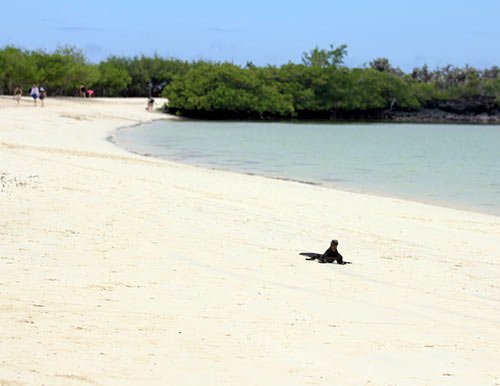
What matters most is the attitude you bring. The Galápagos reward patience and quiet observation. If you approach a blue-footed booby slowly and let it set the terms of the encounter, you will see behavior that a rushed visitor would miss. The same goes for the giant tortoise. Stand still and wait, and it might decide to walk right past you, a slow and deliberate procession that feels almost ceremonial.
Islands Worth Your Time
Each island in the archipelago has its own character. Santa Cruz is the hub of human activity, home to Puerto Ayora and the Charles Darwin Research Station. It is where you will find the most developed infrastructure, but also some of the best opportunities to see giant tortoises in a semi-wild setting. San Cristóbal, to the east, offers striking landscapes and excellent snorkeling sites, including a sheltered bay where sea lions gather in large numbers.
Isabela is the largest island and the most volcanically active. Its terrain is rugged and dramatic, with lava fields that feel almost lunar. Bartolomé, though small, features one of the most photographed viewpoints in the archipelago, a steep climb that rewards you with a panoramic view of the surrounding islands. Between these landings, the time spent on the water is just as valuable. The crossing from one island to another is a chance to spot dolphins, whales, and seabirds, and to feel the vastness of the Pacific.
Practical Considerations for a Serious Trip
Getting to the Galápagos requires flying into Ecuador first, then connecting to either Baltra or San Cristóbal. From there, the cruise operator handles the rest. The best time to visit depends on what you want to see. The warm season, from December to May, brings calmer seas and better visibility for snorkeling. The cooler season, from June to November, offers more active wildlife, including the famous courtship displays of the blue-footed booby and the arrival of migratory species.

Packing for a trip like this means prioritizing lightweight, quick-drying clothing, sturdy walking shoes, and plenty of sunscreen. A waterproof bag for your camera is essential. The sun at the equator is intense, even on overcast days, and the combination of saltwater and volcanic dust can be hard on electronics. But these are minor concerns compared to the experience itself.
There is a moment that stays with most visitors. It might come while floating in the clear water off a beach on Santa Cruz, watching a sea lion glide past in a spiral of bubbles. Or it might come on a quiet evening aboard the luxury yacht, standing on the deck as the sun sets behind the silhouette of Isabela, with the only sound being the whisper of the wind. That is the real meaning of a natural paradise galápagos. It is not a phrase to sell tickets. It is a description of a place that still works the way nature intended, and of a way of traveling that lets you see it clearly.
Ends · MYNATURALPARADISEGALAPAGOSTALK